1. Semantic Definition, Kinematics, and Mechanical Fundamentals of Precision Turned Components
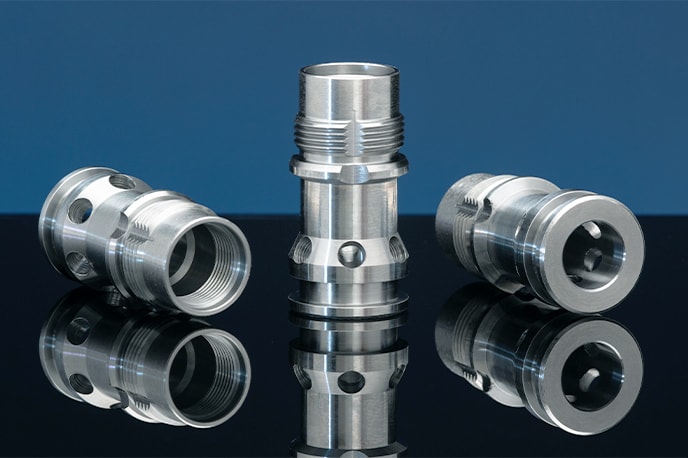
In modern industrial contract manufacturing, Precision Turned Components are highly specialized, rotationally symmetrical hardware engineered via subtractive computer numerical control (CNC) or cam-actuated machining operations. Unlike standard milled prismatic geometries, turned parts are generated by spinning raw bar stock (such as round, hex, or square profiles) around a central axis of rotation while stationary or driven cutting tools engage the work material along multiple linear and rotational axes (X, Y, Z, C, and B axes).
For global procurement officers, system integrators, and mechanical engineering teams sourcing parts at scale, turned components represent the mechanical backbone of fluid power regulation, aerospace actuation, medical instrumentation, and automotive powertrain assemblies. Achieving dimensional stability across multi-thousand or multi-million unit production runs requires deep expertise in metal cutting mechanics, thermal expansion management, chip control dynamics, and sub-micron tool geometry selection.
Information Gain Note: Turned Component Kinematics & Geometric Tolerancing
Standard turned parts often fail in field applications not due to nominal dimensional error, but because of geometric compliance issues such as runout, concentricity, cylindrical error, and surface micro-roughness. At DuPage Machine Products, turned parts undergo rigid geometric dimensioning and tolerancing (GD&T) verification under controlled ambient conditions (+/- 1°F) to ensure absolute alignment of mating features down to ±0.0002 inches (5 microns).
Extreme Concentricity and Cylindricity: Crucial for high-RPM rotating shafts, hydraulic valve spools, and press-fit bushings to prevent mechanical vibration, fluid bypass, and localized wear.
Micro-Inch Surface Finishes: Achieving Ra 16 to Ra 32 micro-inch finishes directly off the machine spindle, eliminating costly secondary grinding or burnishing operations.
Multi-Feature Complexity in Single Setups: Integrating cross-drilling, keyway milling, back-boring, polygon turning, and internal thread chasing using live tooling within one continuous machining cycle.
Tight Tolerance Diameter Control: Consistent execution of outer diameter (OD) and inner diameter (ID) tolerances tight to ±0.0002 inches across extended shift runs.
Global original equipment manufacturers (OEMs) demand component solutions optimized for specific environmental stressors, thermal cycles, operating pressures, and mechanical loads. Below is an engineering product showcase highlighting core precision turned components manufactured at DuPage Machine Products.
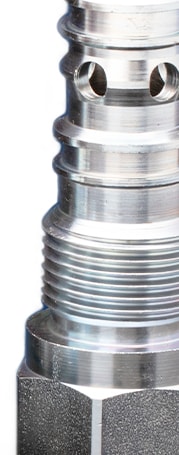
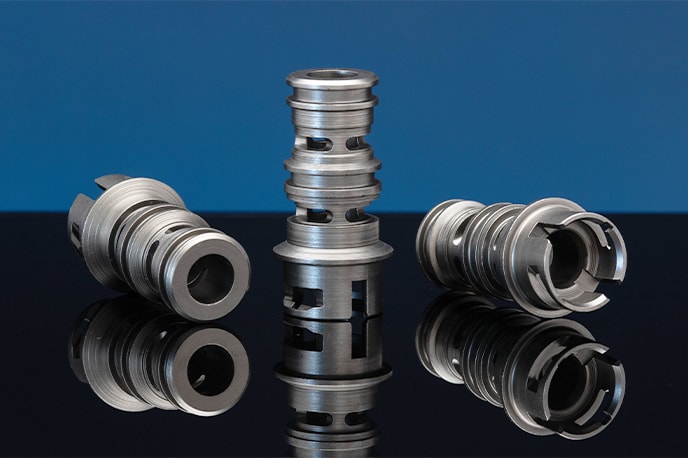
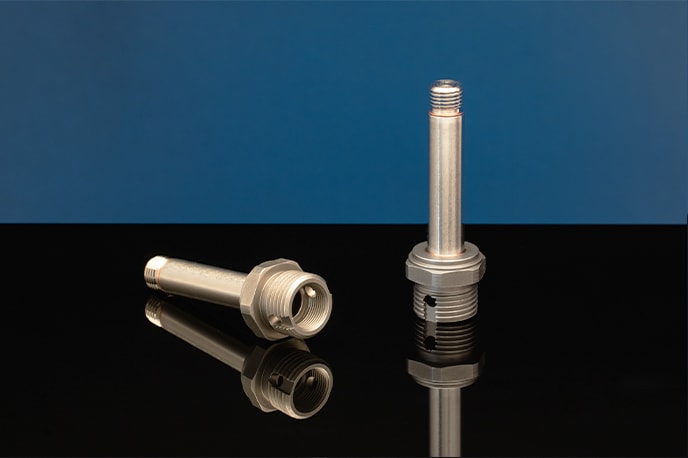
Hydraulic Valve Spools & Cartridges
Engineered for high-pressure fluid power systems operating up to 5,000 PSI. Features micro-finished metering lands, razor-sharp edge control, and precise radial clearances to eliminate internal leakage in mobile and industrial hydraulics.
Typical Tolerances: OD clearance ±0.00015", Cylindricity within 0.00008"
Applications: Proportional control valves, steering units, pump pistons
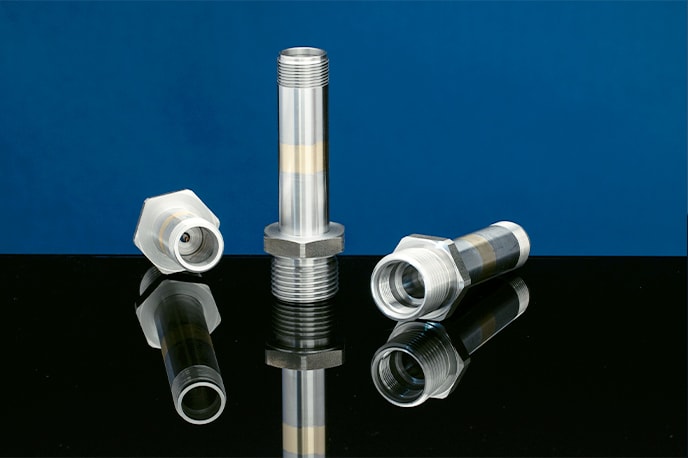
Aerospace Fasteners & Shaft Assemblies
High-reliability structural turned components designed to withstand extreme thermal variation and continuous stress. Fully compliant with AS9100D aerospace quality standards and strict material traceability requirements.
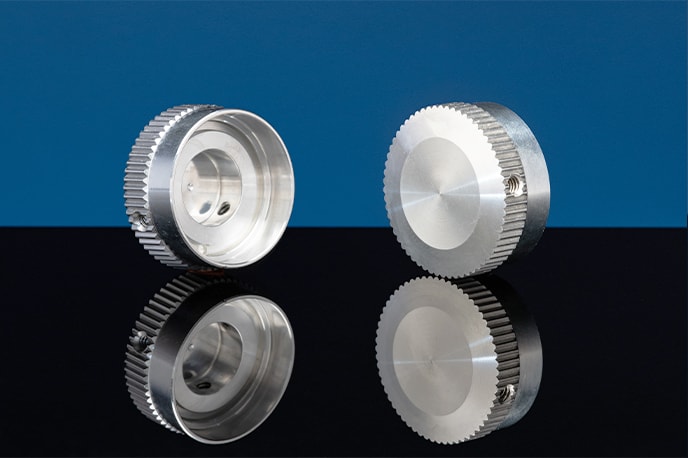
Sub-miniature components manufactured on specialized Swiss CNC lathes. Engineered with pristine surface finishes, zero burr tolerances under 10x magnification, and bio-compatible metal alloys.
High-volume turned components produced at rates exceeding thousands of parts per hour via multi-spindle turning technology. Designed for high durability in heavy-duty commercial vehicle engines and transmissions.
Selecting the optimal material, tooling approach, and manufacturing method for precision turned components requires evaluating mechanical properties against total unit production cost. The table below serves as a technical decision-making matrix for OEM engineering teams:
Material Category
Common Material Grades
Machinability Index (%)
Achievable Tolerance
Optimal Machining Platform
Primary Industry Sector
Free-Cutting Steel
12L14, 1215, 11SMn30
130% – 180%
± 0.0002 in (0.005 mm)
CAM & CNC Multi-Spindle
Hydraulics & Automotive
Alloy & Carbon Steel
4140, 8620, 1045, 4340
65% – 75%
± 0.0003 in (0.008 mm)
CNC Multi-Spindle / Rotary
Heavy Equipment & Transmission
Austenitic Stainless
303, 304, 316 / 316L
45% – 78%
± 0.0002 in (0.005 mm)
Swiss CNC & CNC Turning
Medical, Food & Chemical
Martensitic Stainless
416, 420, 440C, 17-4PH
50% – 110%
± 0.0002 in (0.005 mm)
Swiss CNC / Multi-Spindle
Aerospace & High-Pressure Valves
Brass & Bronze Alloys
C36000 Free-Cutting, C93200
100% – 200%
± 0.00015 in (0.004 mm)
Multi-Spindle & Rotary Transfer
Fluid Fittings, Electrical Hardware
Aluminum Alloys
6061-T6, 2024-T4, 7075-T6
150% – 300%
± 0.0003 in (0.008 mm)
CNC Turning & Multi-Spindle
Aerospace, Automotive, Defense
Exotic Superalloys
Inconel 718, Titanium Gr. 5
15% – 30%
± 0.0002 in (0.005 mm)
High-Rigidity Swiss CNC Lathes
Aerospace Propulsion, Implants
3. High-Volume Machining Technologies: CNC Multi-Spindle, Swiss CNC, and Rotary Transfer
Choosing the correct machine architecture for precision turned components is the single largest factor governing unit cost, lead time, and part consistency. DuPage Machine Products operates over 150 advanced machining centers across a 245,000 square foot facility, deploying specialized technologies based on part length-to-diameter ratio, geometry complexity, and order volume.
CNC Multi-Spindle Turning Technology
CNC multi-spindle machines feature multiple rotating spindles (typically 6 or 8) operating simultaneously in a drum index sequence. Each position performs specific roughing, finishing, threading, or back-working operations concurrently.
Cost Impact: Reduces cycle times by 300% to 500% compared to traditional single-spindle CNC turning centers, making multi-spindle turning the premier choice for order quantities exceeding 10,000 to 1,000,000+ units.
Swiss CNC Single-Spindle Machining
Swiss turning centers utilize a sliding headstock and guide bushing mechanism where the bar stock moves through the bushing past stationary cutting tools. The cutting action takes place millimeters away from the support point, eliminating deflection caused by cutting forces.
Ideal Application: Perfect for long, slender parts (length-to-diameter ratios greater than 4:1) such as medical shafts, micro-pins, and complex aerospace pins requiring extreme concentricity.
In-House Tool Manufacturing & CAD/CAM Engineering
A primary bottleneck in precision turned component supply chains is reliance on third-party perishable tooling suppliers. DuPage Machine Products eliminates this vulnerability through an integrated, in-house tool manufacturing center. Utilizing 3D CAD/CAM programming platforms alongside high-precision CNC tool grinders, our engineers design custom form tools, step drills, broaches, and specialized insert profiles tailored to specific workpiece geometries. This internal capability dramatically reduces tooling lead times from weeks to hours, allowing rapid design iterations and optimized chip evacuation dynamics.
The global manufacturing ecosystem is undergoing unprecedented structural shifts. Procurement executives seeking competitive advantages must evaluate how emerging technologies and global supply chain realignments impact custom precision turned component manufacturing over the next decade.
1. Transition to AI-Powered Generative DFM & Predictive Quality Analytics
Artificial intelligence is shifting Design for Manufacturability (DFM) from reactive engineering feedback to real-time generative suggestions. During the digital quoting phase, AI algorithms evaluate component CAD models to identify chip-trapping blind holes, sharp internal corner radii, and thin-wall vibration risks. In production, closed-loop machine learning sensor networks analyze spindle vibration and acoustic emissions to detect tool wear micro-fractures before dimensional drift occurs, ensuring 100% in-tolerance yield.
2. Reshoring and Nearshoring of Mission-Critical Turning Work
Geopolitical friction, international freight disruptions, and intellectual property concerns have exposed vulnerabilities in long-distance supply chains. Global OEMs are increasingly consolidating turned component contracts with North American tier-1 manufacturers who possess multi-spindle and automated cell capacity. Buying teams prioritize suppliers with expansive floor footprints—such as DuPage’s 245,000 sq. ft. facility—that offer safety stock warehousing, Kanban stocking programs, and predictable land-freight logistics.
3. Industry 4.0 "Lights-Out" Automated Machining
The future of cost-competitive high-volume precision turning lies in unassisted, continuous manufacturing. High-capacity automatic bar loaders, chip conveyors, integrated high-pressure coolant units (up to 2,000 PSI), and robotic part-handling arms enable 24/7 continuous operation without human intervention. This lights-out manufacturing model dramatically lowers labor overhead per piece, enabling domestic production to match or beat overseas pricing while delivering superior quality compliance.
Corporate sustainability mandates are transforming machine shop operations. Modern precision turning facilities utilize closed-loop chip centrifuges and briquetting presses to reclaim over 98% of neat cutting oils and water-soluble coolants. Metallic turnings and swarf are segregated by alloy family and compressed for direct remelting, minimizing the carbon footprint of raw metal sourcing and providing verifiable ESG metrics for OEM sustainability audits.
5. High-Volume Precision Turned Components FAQ: Expert Answers to Global Sourcing Queries
Below are detailed responses to the most critical technical and logistical questions asked by OEM purchasing directors, supply chain managers, and senior manufacturing engineers when evaluating contract turned part suppliers.
Q1: How do CNC multi-spindle machines lower unit costs compared to single-spindle lathes for turned components?
Multi-spindle machining centers utilize six or eight independent spindles rotating simultaneously. Rather than completing every machining step sequentially on a single spindle, the operations (drilling, turning, threading, grooving, reaming) are divided across all positions. When the drum indexes, a completed component drops off the machine every few seconds. This reduces cycle times by up to 80% compared to standard single-spindle CNC lathes, yielding significant unit cost reductions on medium-to-high volume production runs (typically 10,000 parts and up).
Q2: What DFM parameters should be optimized to reduce cycle times on precision turned parts?
To optimize cycle times and unit cost:
Standardize Thread Specifications: Specify standard UN, Metric, or NPT threads that utilize stock thread chasers or taps rather than custom pitch geometries.
Provide Tool Radius Clearance: Avoid sharp internal 90° shoulders. Allow a minimum radius of 0.015" (0.38mm) or undercut relief grooves to allow standard turning inserts to operate at peak cutting speeds.
Optimize Hole Depth-to-Diameter Ratios: Keep internal drilled holes under 4x diameter where possible to prevent the need for multiple peck-drilling cycles.
Select Free-Machining Alloys: Specify materials like 12L14 steel or C360 Brass when mechanical requirements permit, as they allow significantly higher surface feet per minute (SFM).
Q3: How does DuPage Machine Products maintain ±0.0002" tolerances across multi-shift production runs?
Maintaining micro-inch precision over continuous production runs requires a multi-layered engineering protocol:
Climate-Controlled Production Floor: Operating within a temperature-stabilized environment prevents thermal expansion of machine beds, linear scales, and spindle housings.
Automated Tool Compensation: CNC turning centers feature laser or touch-probe tool setters that automatically adjust offset parameters based on real-time tool wear measurements.
Statistical Process Control (SPC): In-process inspection stations utilize high-accuracy CMMs, optical comparators, and air gaging tied to real-time SPC software to detect micro-trends prior to parts drifting out of control limits.
Q4: What quality control documentation and certifications are provided with precision turned part shipments?
DuPage Machine Products operates under AS9100D and ISO 9001:2015 certified quality management systems. Depending on customer requirements, every shipment can be accompanied by complete documentation packages including:
Material Test Reports (MTRs) with full chemical and mechanical mill heat traceability.
Production Part Approval Process (PPAP) documentation up to Level 3.
First Article Inspection Reports (FAIR) per AS9102 standards.
Certificates of Conformance (C of C) for external heat treating, plating, and anodizing.
CMM dimensional verification charts and SPC capability data (Cpk / Ppk analysis).
Q5: When should an engineering team select Swiss CNC machining over multi-spindle turning?
Swiss CNC turning is recommended when component geometry exhibits an aspect ratio (length divided by diameter) greater than 4:1, or when part diameters are under 1.25" (31.75mm) with intricate micro-features. Because Swiss lathes support the workpiece right at the cutting tool with a guide bushing, chatter and deflection are eliminated. Conversely, multi-spindle turning is preferred for high-volume parts with lower aspect ratios where maximum output speed and low per-piece tooling cost are paramount.
Q6: What secondary operations and finishing processes are handled in-house?
To provide a complete turnkey component solution, DuPage manages extensive secondary and finishing operations including precision centerless grinding, induction heat treating, deburring (thermal, electrochemical, and vibratory), ultrasonic part washing, assembly, and automated 100% vision sorting.
Q7: How does DuPage Machine Products assist buyers with supply chain risk mitigation?
DuPage mitigates risk for global OEMs through strategic inventory management programs including Vendor-Managed Inventory (VMI), blanket order schedules with release triggers, buffer stock hold agreements, and direct electronic data interchange (EDI) integration. Operating out of a massive 245,000 sq. ft. campus gives us the warehousing floor space necessary to hold raw bar stock and finished safety stock for immediate dispatch.
6. Enterprise Advantage & E-E-A-T Proof: Why World Leaders Partner with DuPage
For over 50 years, DuPage Machine Products has demonstrated unyielding commitment to manufacturing excellence, capital investment, and quality assurance. Our manufacturing enterprise represents the benchmark for North American contract precision turned component production.
Core Infrastructure & Capability Highlights
245,000 Square Feet: World-class, climate-controlled manufacturing facility designed for lean material flow.
150+ Production Machines: High-end CNC multi-spindle, Swiss CNC, rotary transfer, and single-spindle centers.
Certified Quality Systems: Dual AS9100D (Aerospace) and ISO 9001:2015 certifications.
In-House Tooling & Engineering: Complete CAD/CAM design studio and custom cutting tool grinding shop.
50+ Years Experience: Proven technical longevity serving global blue-chip OEMs across 5 key industries.
Trusted Partner to Global OEM Leaders
We are proud to serve as a strategic tier-1 vendor to world-renowned manufacturing brands including Parker Hannifin, Sun Hydraulics, Danfoss, Cummins, Haldex, HYDAC, and Leupold. Our precision turned components power heavy hydraulic machinery, commercial vehicles, aerospace defense platforms, and life-saving medical systems daily.
7. Partner with DuPage Machine Products: Initiate Your Technical Engineering Inquiry
Whether you are launching a new high-volume OEM manufacturing project, seeking DFM optimization to reduce existing unit production costs, or re-shoring a critical precision turned component supply chain, DuPage Machine Products possesses the engineering depth, machine capacity, and quality management systems required to execute your exact specifications.
Our senior engineering group stands ready to review your CAD files (STEP, IGES, SolidWorks, DWG), evaluate material constraints, provide comprehensive DFM feedback, and deliver competitive contract pricing.
Ready to Optimize Your Precision Turned Component Sourcing?
Connect immediately with our technical engineering group to discuss part tolerances, material selection, volume pricing, and production scheduling.