1. The Micro-Precision Imperative in Aerospace Components
Modern commercial aircraft, defense airframes, satellite payloads, and propulsion systems operate under extreme thermal, vibrational, and mechanical stresses. Within these flight-critical architectures, single-point mechanical failures are unacceptable. Consequently, Aerospace Precision Machined Components are designed to meet structural, metallurgical, and dimensional tolerances that surpass standard industrial manufacturing by orders of magnitude.
Global aerospace buyers, procurement engineers, and supply-chain directors evaluating high-volume contract manufacturing partners prioritize three main pillars: dimensional repeatability (achieving tight tolerances such as ±0.0001” / 2.5 microns across high volume runs), material integrity (complete heat-lot traceability, DFARS material sourcing compliance, and zero structural inclusions), and strict compliance to international aerospace quality frameworks such as AS9100D and ISO 9001:2015.
At DuPage Machine Products, operating out of our 245,000 sq. ft. climate-controlled facility in Bloomingdale, Illinois, we combine over 50 years of manufacturing engineering heritage with more than 150 high-end CNC machine tools. Our multi-spindle CNC, Swiss CNC single-spindle, and CNC rotary transfer equipment enable us to manufacture complex turned parts with ultra-precise internal geometries, micro-bore concentricity, and fine surface finishes (down to Ra 8 micro-inches).
Technical Alloy Metallurgy for Next-Gen Aerospace Machining
Selecting and machining high-performance aerospace alloys requires extensive thermal management expertise, custom carbide/PCD tooling, and spindle dynamics tuning to prevent work-hardening and micro-cracks. Below is an engineering overview of the primary metallurgy processed across our facility:
| Aerospace Alloy Grade | Mechanical & Thermal Properties | Critical Aerospace Applications | Achievable Tolerances & Finish |
|---|---|---|---|
| Titanium Ti-6Al-4V (Grade 5) | High strength-to-weight ratio, superior corrosion resistance, high heat tolerance up to 400°C. | Fasteners, hydraulic fittings, engine mount brackets, structural pins, turbine hardware. | Tolerances to ±0.0002" (5µm) Surface finish: Ra 16 µin |
| Inconel 718 / 625 (Nickel Superalloys) | Exceptional creep-rupture strength at high temperatures up to 700°C, resistance to severe oxidation. | Jet engine combustor nozzles, turbine shaft sleeves, bleed air valve shafts, exhaust studs. | Tolerances to ±0.00015" (3.8µm) Surface finish: Ra 8 µin |
| 15-5 PH & 17-4 PH Stainless Steel | Precipitation-hardening stainless steel combining high hardness, strength, and corrosion resistance. | Landing gear pins, actuator shafts, hydraulic valve spools, flight control linkages. | Tolerances to ±0.0001" (2.5µm) Surface finish: Ra 12 µin |
| Aerospace Aluminum 7075-T6 & 2024-T3 | Lightweight, high yield strength, excellent fatigue resistance for structural components. | Avionics enclosures, connector shells, sensor housings, hydraulic manifold bodies. | Tolerances to ±0.0002" (5µm) Surface finish: Ra 16 µin |
| Hastelloy C-276 & Waspaloy | Extreme resistance to aggressive chemical environments and extreme heat cycles. | Spacecraft propulsion valves, high-pressure fuel lines, defense missile system hardware. | Tolerances to ±0.0002" (5µm) Surface finish: Ra 16 µin |
2. Product Recommendations: Precision Machined Aerospace Components
Procurement teams sourcing parts for commercial airliners, military aircraft, UAVs, and satellite constellations require components engineered for seamless sub-assembly integration. DuPage Machine Products specializes in high-volume, contract-turned components across five distinct aerospace hardware categories:
A. Flight Control & Hydraulic Valve Spools
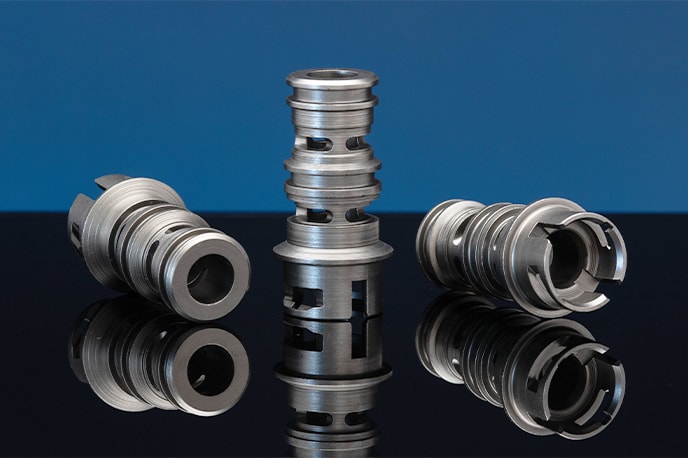
High-precision hydraulic valve spools, poppets, sleeves, and manifold fittings manufactured for fly-by-wire flight control systems, braking assemblies, and landing gear actuation.
- Machining Platform: Swiss CNC / Multi-Spindle
- Concentricity / Cylindricity: < 0.00008" (2.0 µm)
- Materials: 15-5 PH, 440C Stainless, Titanium
- Production Volumes: 10,000 to 1,000,000+ units
Features zero-burr intersection milling under 30x optical inspection and 100% pneumatic seat-leak testing readiness.
B. High-Temperature Jet Engine & Turbine Fasteners
Specialty flight-critical threaded fasteners, engine studs, shear bolts, and self-locking nuts engineered to withstand high vibration and thermal cycling without galling or fatigue failure.
- Machining Platform: CNC Rotary Transfer / Swiss CNC
- Thread Class: UNJ / UNR Class 3A Precision Threads
- Materials: Inconel 718, Waspaloy, Titanium Gr. 5
- Production Volumes: 50,000 to 5,000,000+ units
Produced with rolled threads for enhanced fatigue life and high-speed multi-station drilling.
C. Avionics & Satellite Hermetic Connector Shells
Complex turned and milled micro-connector housings, RF shield bodies, and sensor mounting hardware designed for space payload electronics and radar systems.
- Machining Platform: Swiss CNC Single Spindle
- Wall Thickness Tolerance: ±0.0005" (12.7 µm)
- Materials: Aluminum 6061-T6/7075, Kovar, Brass
- Production Volumes: 5,000 to 500,000+ units
Capable of multi-axis back-working and micro-slotting in a single automated machining cycle.
D. Fuel System Metering Shafts & Injection Nozzles
Precision fuel metering shafts, pump pistons, check valves, and injection nozzle bodies for commercial turbofans, APUs, and military jet propulsion systems.
- Machining Platform: CNC Multi-Spindle / Swiss CNC
- Micro-Bore Diameter: Down to 0.015" (0.38 mm)
- Materials: 316L, 17-4 PH, Inconel 625
- Production Volumes: 20,000 to 2,000,000+ units
Features deep-hole drilling with continuous high-pressure coolant flushing to eliminate internal tool chatter marks.
3. Future Procurement & Technological Trends in Aerospace Machining
As global aerospace original equipment manufacturers (OEMs) like Boeing, Airbus, Lockheed Martin, and Northrop Grumman ramp up production rates for next-generation narrowbody aircraft, defense platforms, and satellite constellations, global procurement strategies are shifting dramatically. Buyers must align with contract manufacturers capable of navigating four major industry disruptions over the next decade:
Nearshoring & North American Supply Chain Resilience
Geopolitical tensions, maritime shipping delays, and tariff volatility have made long-distance supply chains a major risk factor. Aerospace procurement directors are actively reshoring critical component manufacturing to North American Tier-1 and Tier-2 suppliers who offer high-volume production, ITAR compliance, and verified raw material sourcing under DFARS regulations.
Digital Twins & Automated Closed-Loop Quality
Future aerospace procurement will mandate end-to-end digital traceability. Advanced contract manufacturers are embedding CMM telemetry, automated optical inspection (AOI), and digital twin modeling into the production line. Every batch of Aerospace Precision Machined Components will carry a digital passkey containing raw material Mill Test Reports (MTR), heat-treat logs, and full dimensional inspection certificates.
Hybrid Additive & Subtractive Manufacturing Integration
While additive manufacturing (3D printing) enables complex internal lattice structures for aerospace components, final critical sealing surfaces, thread profiles, and tight-tolerance bores still require high-precision subtractive machining. The industry standard is shifting toward hybrid workflows: 3D-printed titanium or Inconel near-net shape blanks finished on multi-axis Swiss CNC equipment to reach final micrometer-level specs.
Sustainable Machining & ESG Compliance
Aerospace supply chains are adopting strict environmental management goals. OEMs now evaluate contract machining suppliers based on coolant recycling, eco-friendly metal chip reclamation, energy-efficient CNC drives, and Minimum Quantity Lubrication (MQL) processing to reduce total carbon footprint during high-volume component machining.
DuPage Procurement Insight: Preparing for Aircraft Production Rate Ramps
With global commercial aircraft backlog expanding into the 2030s, OEMs cannot afford supply chain bottlenecks driven by machining capacity limits. Partnering with a manufacturer equipped with 150+ CNC production machines across a 245,000 sq. ft. facility guarantees scale, financial stability, and uninterrupted delivery for long-term contract manufacturing agreements.
4. Frequently Asked Questions (FAQ) for Aerospace Component Procurement
Below are detailed responses to the most common technical and operational questions posed by global procurement managers, manufacturing engineers, and sourcing agents when selecting an aerospace machining partner:
What quality certifications does DuPage Machine Products hold for aerospace manufacturing?
DuPage Machine Products is fully certified under AS9100D (Aerospace Quality Management System Standard) and ISO 9001:2015. Our quality management system strictly adheres to aerospace traceability, contract review, configuration management, and First Article Inspection (FAI) reporting per SAE AS9102 guidelines. Download our official AS9100D certification certificate here.
What dimensional tolerances and surface finishes can your facility reliably achieve?
Equipped with high-precision Swiss CNC single-spindle and multi-spindle production equipment, we routinely hold outer/inner diameter tolerances down to ±0.0001 inches (2.5 microns) and concentricity to within 0.00008 inches (2.0 microns). Using specialized micro-finishing, burnishing, and diamond-tooled operations, we achieve surface finishes as fine as Ra 8 micro-inches across stainless steel, titanium, and nickel alloys.
How do CNC Multi-Spindle and Swiss CNC technologies compare for high-volume aerospace parts?
Swiss CNC Single-Spindle machining is ideal for slender, long, or complex multi-axis aerospace components (e.g., valve shafts, connectors, pins) requiring sliding headstock support to prevent part deflection during machining. CNC Multi-Spindle machining utilizes 6 or 8 spindles operating simultaneously to produce turned parts at ultra-high production speeds, reducing cycle times by up to 300% on high-volume runs (50,000+ pieces) without sacrificing precision.
Does DuPage comply with ITAR and DFARS material sourcing standards?
Yes. DuPage Machine Products adheres strictly to International Traffic in Arms Regulations (ITAR) security protocols for defense contracts and ensures full compliance with Defense Federal Acquisition Regulation Supplement (DFARS) requirements for specialty metals. Every raw material shipment is accompanied by complete chemical and physical Mill Test Reports (MTRs) tracing back to accredited domestic or qualified foreign melting mills.
What secondary operations and surface finishing services do you provide?
To deliver fully finished, drop-in assembly components, we provide comprehensive in-house and Nadcap-partnered secondary processes, including centerless grinding, precision honing, thread rolling, micro-cleaning, robotic welding, passivating (AMS 2700), anodizing, electropolishing, heat treating, and automated 100% optical sorting.
What production volumes are ideal for contract manufacturing at DuPage?
Our 245,000 sq. ft. facility is optimized for medium-to-high volume production runs ranging from 5,000 units to several million pieces annually. Our high machine count (150+ units) allows us to dedicate equipment for continuous long-term production contracts, ensuring supply continuity and stable lead times for global OEMs.
Why Global Aerospace Tier-1 Brands Partner with DuPage Machine Products
With over five decades of operational excellence, DuPage Machine Products has earned its reputation as a world-leading contract manufacturer of precision machined turned components. Our investment in infrastructure, talent, and quality controls delivers tangible advantages for complex aerospace programs:
245,000 Sq. Ft. Facility
Climate-controlled manufacturing space designed for thermal stability, optimal machine performance, and continuous production expansion.
150+ High-End CNC Machines
Unmatched production redundancy featuring multi-spindle CNC, Swiss CNC, and rotary transfer machines to eliminate capacity bottlenecks.
In-House Tool Manufacturing
Custom tool design and grinding capabilities that shorten setup times, lower tooling costs, and allow machining of complex part features.
Advanced CAD/CAM Integration
Seamless transition from engineering CAD models to multi-axis machine code, ensuring fast turnarounds for complex aerospace geometries.
AS9100D & ISO 9001 Certification
Rigorous quality controls backed by CMM equipment, optical gauging, and AS9102 First Article Inspection reports.
50+ Years Manufacturing Heritage
Decades of deep process knowledge, continuous improvement initiatives, and stable financial leadership dedicated to long-term client success.