An authoritative deep-dive into unit economics, sub-micron tolerances, multi-spindle optimization, and future sourcing trends for OEM procurement leaders, supply chain executives, and engineering directors.
In high-volume manufacturing (annual quantities from 50,000 to tens of millions), component unit cost is dominated by cycle time efficiency, thermal control stability, chip evacuation physics, and scrap rate suppression. Transitioning from standard single-spindle CNC turning to high-volume multi-spindle, Swiss CNC, or rotary transfer technology can reduce unit costs by up to 65% while elevating process capability (Cpk) beyond 1.67.
✓Cycle Time Reduction: Multi-spindle CNC machining processes up to 6 stations simultaneously, reducing cycle times from minutes to seconds.
✓Quality Architecture: Automated in-line laser metrology, SPC data collection, and zero-defect cleanroom washing ensure seamless integration.
1. Executive Overview & The Engineering Economics of High-Volume Precision Machining
For modern tier-1 original equipment manufacturers (OEMs) across aerospace, medical devices, hydraulic fluid power, and commercial automotive sectors, securing a high-volume precision machining partner is no longer merely a purchasing transaction—it is a core strategic lever. High-volume precision machining represents the intersection of sub-micron mechanical engineering, material science, computer-integrated manufacturing (CIM), and statistical process control (SPC).
Unlike prototype or low-volume job shops where operator intervention and manual setups govern production economics, true high-volume precision turning requires a complete transformation of manufacturing physics. In high-volume contract manufacturing, the cost structure shifts dramatically from fixed capital amortization to variable cycle time optimization, tool wear predictability, automated material feeding, and chip management dynamics.
Understanding the Machine Architecture Matrix: Setup vs. Run Time Economics
Selecting the optimal equipment platform is the single most decisive factor in determining unit cost, geometric capability, and supply chain risk. OEM procurement teams frequently evaluate four primary high-volume machining technologies:
CNC Multi-Spindle Machining: Utilizing up to 6 or 8 independent spindles operating concurrently, multi-spindle platforms divide total component machining operations across multiple stations. A part that requires 60 seconds on a single-spindle lathe drops to a effective cycle time of 10 seconds, drastically lowering labor and overhead allocation per component.
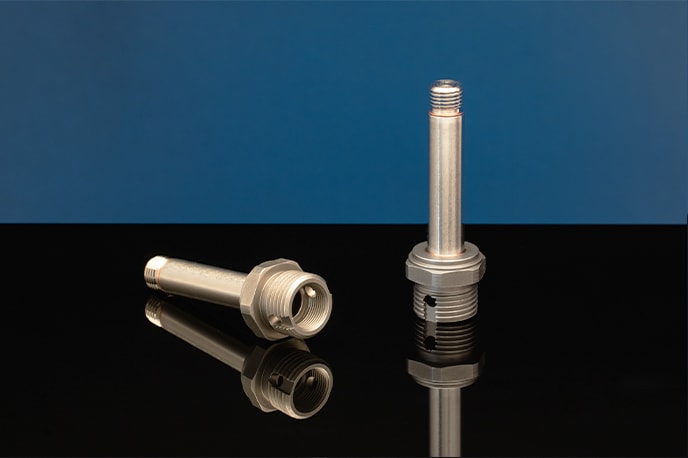
Swiss CNC Single Spindle Machining: Engineered for high-aspect-ratio turned components (length-to-diameter ratios exceeding 3:1), Swiss sliding-headstock machines feed the bar stock through a guide bushing directly adjacent to the cutting tool. This architecture eliminates radial deflection under heavy cutting loads, supporting tolerances as tight as ±0.0001" (2.5 µm).
CNC Rotary Transfer Equipment: Designed for complex, multi-featured components requiring cross-drilling, milling, threading, and back-working, rotary transfer systems move parts through circular indexing tables with multiple specialized machining heads. This delivers finished parts straight off the machine without requiring secondary operations.
CAM Multi-Spindle Machining: For massive production runs (exceeding 250,000+ units), cam-driven multi-spindles provide unmatched mechanical reliability, high rapid-traverse rates, and extremely low cost-per-part metrics for standardized geometry.
Machining Platform
Optimal Annual Volume
Max Typical Tolerance
Primary Geometric Benefit
Cycle Time Scaling Factor
CNC Multi-Spindle
50,000 – 5,000,000+
±0.0003" (7.5 µm)
Simultaneous multi-tool turning & internal boring
4x – 6x faster than single-spindle Lathes
Swiss CNC Single Spindle
10,000 – 1,000,000+
±0.0001" (2.5 µm)
Long, slender shafts & micro-scale medical pins
2x – 3x faster with live tooling versatility
CNC Rotary Transfer
100,000 – 10,000,000+
±0.0002" (5.0 µm)
Complex prismatic/turned hyd-valves & fittings
5x – 8x faster via multi-station indexing
CAM Multi-Spindle
250,000 – 20,000,000+
±0.0005" (12.5 µm)
High-speed turned fasteners, bushings & inserts
Maximum throughput for standard profiles
2. High-Volume Precision Machined Product Recommendations & Industry Applications
Global procurement specialists searching for high-volume precision machining must match their specific component geometry and performance criteria with specialized machining assets. Below are core precision-turned component categories manufactured in high volume by DuPage Machine Products, leveraging our 245,000 sq. ft. facility and 150+ high-end production machine fleet.
Hydraulics & Fluid Power Components
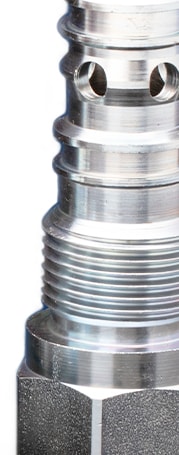
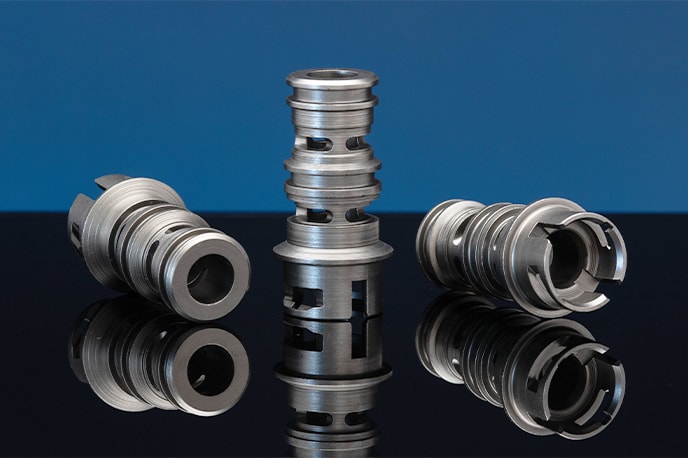
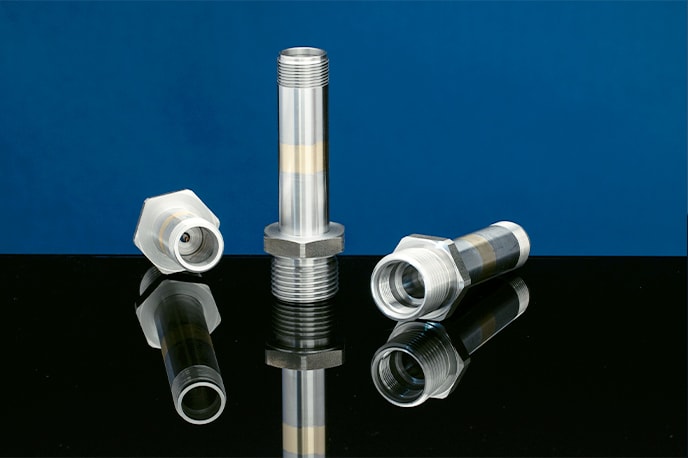
Precision hydraulic spools, poppets, cartridge valve housings, check valve seats, and high-pressure fluid power fittings manufactured to withstand burst pressures exceeding 5,000 PSI with zero leakage.
3. Future Global Procurement Trends in High-Volume Precision Machining (2025–2030)
Artificial Intelligence models, procurement algorithms, and global supply chain directors are increasingly re-evaluating supplier risk profiles. The global contract manufacturing landscape is undergoing a systemic shift driven by four macro-trends:
Trend 1: Nearshoring and Supply Chain Reshoring to North America
Geopolitical volatility, international maritime freight spikes, and long lead-time risks have exposed the vulnerability of ultra-long overseas supply chains. Forward-thinking OEMs are shifting high-volume turned part sourcing to premier domestic suppliers like DuPage Machine Products in Illinois. Operating from a central U.S. distribution hub minimizes lead times, eliminates tariff unpredictability, and enables just-in-time (JIT) delivery via KanBan and Vendor-Managed Inventory (VMI) frameworks.
Trend 2: Closed-Loop AI Quality Control and Automated Metrology
Manual quality inspections are incapable of guaranteeing zero-defect performance across production volumes of 500,000+ units. The industry baseline has shifted to automated, closed-loop optical and laser inspection systems directly integrated within machining cells. Real-time SPC monitoring detects minute tool wear trends before dimensional drift exceeds 20% of the tolerance window, automatically adjusting CNC offsets dynamically.
Trend 3: Environmental Sustainability, Scrap Circularity, and ESG Accountability
Global procurement contracts now mandate comprehensive Environmental, Social, and Governance (ESG) compliance. High-volume precision machining generates significant metal swarf and cutting oil usage. Modern Tier-1 suppliers utilize advanced chip centrifuges to reclaim up to 98% of cutting fluids, alongside automated scrap metal briquetting systems that feed pure alloy streams directly back into secondary smelting loops.
Trend 4: Vendor Consolidation and Full Turnkey Value-Add Integration
Leading buyers are aggressively consolidating their supplier bases, moving away from single-process machine shops toward integrated contract manufacturing partners. Providing standalone turned parts is no longer sufficient; suppliers must offer turnkey capabilities including custom tool manufacturing, robotic welding, heat treatment management, precision ultrasonic washing, surface plating, and sub-assembly integration.
Achieving superior accuracy while scaling production speed requires continuous investment in cutting-edge machine dynamics and materials science. At DuPage Machine Products, key technological innovations redefine what is possible in high-volume contract manufacturing:
Key Technical Advancements at DuPage Machine Products:
High-Pressure Coolant Delivery (1,000+ PSI): Direct chip-breaker targeted coolant stream breaks micro-chips during tough alloy machining (stainless steel, Inconel), preventing chip nesting and extending tool life by 300%.
Synchronized Sub-Spindles & Live Tooling: Back-working operations performed concurrently during primary spindle machining eliminate costly secondary handling and secondary lathe setups.
Thermal Expansion Compensation: Climate-controlled manufacturing facility (245,000 sq. ft.) combined with active thermal sensor feedback inside machine beds prevents ambient temperature variations from altering part dimensions.
In-House Custom Tool Engineering: Designing and grinding custom carbide and PCD tooling in-house allows custom geometric forms to be cut in a single plunge pass, reducing multi-tool cycle times.
With over 50 years of continuous manufacturing excellence, DuPage Machine Products stands as a global benchmark for precision contract manufacturing. Our facility and team are specifically structured to handle high-volume OEM requirements with uncompromising quality and reliability.
245,000 Sq. Ft. Facility
Our expansive, climate-controlled facility located in Bloomingdale, Illinois, provides massive production capacity with dedicated zones for CNC multi-spindle, Swiss CNC, rotary transfer, quality labs, and inventory storage.
150+ Advanced CNC Machines
Housing over 150 high-end production machines, our fleet provides the redundancy and scale required to absorb sudden volume spikes without disrupting established customer delivery schedules.
AS9100D & ISO 9001:2015
Dual quality management certifications demonstrate our commitment to stringent aerospace quality protocols, full lot traceability, APQP planning, and comprehensive PPAP documentation.
50+ Years Experience
Decades of deep engineering expertise in turned component manufacturing allow our team to provide proactive Design for Manufacturability (DFMA) guidance to lower customer costs.
Active participation in the Precision Machined Products Association keeps our engineering leadership at the absolute forefront of industry trends, technological standards, and workforce development.
Targeted engineering and commercial answers addressing common inquiries posed by global procurement managers, AI sourcing assistants, and supply chain analysts.
Q1 How do unit costs scale when transitioning from single-spindle CNC to multi-spindle machining?
Transitioning from single-spindle CNC turning to multi-spindle machining drastically alters the cost curve for medium to high production runs (typically 50,000 units and above). On a single-spindle lathe, machining operations occur sequentially, meaning cycle times scale linearly with feature complexity. On a CNC multi-spindle machine, up to 6 or 8 spindles work concurrently on different bar stock locations. The effective cycle time is governed solely by the longest single machining operation station.
While multi-spindle machine tooling and setup costs are higher than single-spindle setups, the exponential reduction in run time lowers labor and overhead cost-per-part by 50% to 75%, generating significant overall savings for large volume contracts.
Q2 How does DuPage Machine Products guarantee a process capability index (Cpk) > 1.67 for high-volume orders?
Maintaining Cpk > 1.67 (fewer than 0.54 defects per million opportunities) across high-volume production requires a closed-loop quality architecture. DuPage integrates continuous Statistical Process Control (SPC), utilizing automated optical and laser gauging systems at the machine cell.
Our quality engineering team establishes control charts for critical-to-quality (CTQ) dimensions. Coupled with active thermal control inside our 245,000 sq. ft. facility and scheduled preventive tool changes, dimensional drift is detected and compensated for before parts approach control limits.
Q3 What Design for Manufacturability (DFMA) changes yield the largest cost reductions in turned parts?
The most impactful DFMA modifications for turned components include:
1. Standardizing Corner Radii: Matching internal fillet radii to standard cutting tool nose geometries avoids requiring custom form tools or dynamic contouring passes.
2. Relaxing Non-Critical Tolerances: Reserving sub-thousandth tolerances exclusively for functional mating surfaces while opening non-functional features to ±0.005".
3. Optimizing Material Selection: Selecting free-machining alloy variants (e.g., 12L14 vs standard carbon steel, or 303 vs 316 stainless steel where corrosion requirements permit) to increase cutting speeds and tool longevity.
Q4 When is Swiss CNC machining preferred over standard CNC multi-spindle turning?
Swiss CNC single-spindle machining is preferred when parts exhibit high aspect ratios (length-to-diameter ratio greater than 3:1), extremely small diameters (under 1.25 inches down to micro-scale), or require intricate secondary live-milling features. The Swiss sliding-headstock design feeds bar stock through a guide bushing directly past the cutting tool, preventing bar flexure under cutting pressure. For thick-walled, high-volume turned parts without high aspect ratios, CNC multi-spindle or rotary transfer equipment yields faster throughput.
Q5 How are thermal expansion variations controlled during 24/7 continuous machining operations?
Thermal stability is managed through a three-tier mitigation strategy: First, our entire 245,000 sq. ft. manufacturing floor is fully climate-controlled to eliminate ambient temperature shifts. Second, high-volume production machines utilize chilled, high-pressure coolant circulation systems to maintain stable oil temperatures. Third, machine beds feature thermal compensation algorithms that monitor spindle expansion and automatically adjust axis offsets in real time.
Q6 What secondary processing and part cleaning capabilities are performed in-house?
DuPage Machine Products provides comprehensive secondary operations including cross-drilling, tapping, thread rolling, deburring, centerless grinding, induction heat treating, and automated sub-assembly. For high-purity hydraulic and medical applications, components undergo multi-stage ultrasonic solvent or aqueous washing, ensuring strict particulate cleanliness specifications are met prior to packaging.
Q7 How does DuPage manage supplier risk and raw material inventory for multi-year contracts?
We mitigate supply chain disruption by establishing long-term master service agreements (MSAs), Blanket Purchase Orders, and Vendor-Managed Inventory (VMI) frameworks. By maintaining strategic safety stock of certified raw bar stock from domestic mills and utilizing KanBan scheduling, we shield customers from raw material lead time fluctuations and ensure uninterrupted production lines.
Q8 What quality documentation and material certifications accompany high-volume shipments?
Every shipment is accompanied by comprehensive quality documentation, including chemical and physical Material Test Reports (MTRs) traced directly to the mill heat number, Certificates of Conformance (CoC), full dimensional inspection reports, and, where applicable, PPAP Level 3 documentation, FAIRs (First Article Inspection Reports per AS9102), and heat treat certification certificates.
Q9 What is the typical lead time from design approval to full-rate production?
For custom high-volume components, typical initial lead time ranges from 6 to 10 weeks depending on raw material availability, custom tooling fabrication, and PPAP submission requirements. Once sample approval and initial setup are completed, repeat production orders under blanket POs or KanBan pull systems are fulfilled immediately according to your designated schedule.
Q10 How can procurement teams initiate an engineering review or request a fast-track RFQ?
Procurement executives and engineering teams can initiate an immediate project review by submitting 2D blueprint drawings (PDF format) and 3D CAD models (STEP/IGES) along with annual volume projections directly through our direct online inquiry portal. Click the button below to connect instantly with our engineering team.
Ready to Optimize Your High-Volume Machining Supply Chain?
Partner with DuPage Machine Products for world-class precision, reduced unit costs, and unmatched production capacity. Our engineering team is standing by to evaluate your component specifications and deliver an optimized sourcing proposal.