CNC Multi-Spindle Machining for High-Volume Global Procurement: Architectural Overview, Cost Drivers, & Technical Buying Guide
A definitive technical and commercial resource engineered for procurement executives, strategic sourcing directors, and OEM design engineers. Learn how modern CNC multi-spindle turning technology slashes unit piece price, cuts cycle times by up to 80%, and delivers sub-mil accuracy across mission-critical high-volume production programs.
245,000 Sq. Ft. U.S. Facility
150+ High-End Production CNCs
AS9100D & ISO 9001:2015 Certified
50+ Years Manufacturing Heritage
Key Sourcing Takeaways & Information Gain Summary
Cycle Time Reduction: Multi-spindle CNC turning executes concurrent operations across 6 to 8 independent spindles, reducing complex part cycle times from minutes on a single-spindle machine to mere seconds.
Economic Threshold: The optimum volume cross-over for CNC multi-spindle manufacturing typically starts at 25,000 to 50,000+ units annually, yielding a drastically lower Total Cost of Ownership (TCO).
Superior Precision vs. Mechanical CAMs: Servo-driven Independent Spindle Drives eliminate mechanical cam float, providing continuous C-axis live tooling, complex thread milling, and tight-tolerance control (±0.0003 in / ±0.0076 mm).
Supply Chain Resilience: DuPage Machine Products mitigates global disruption risks through localized domestic manufacturing in Bloomingdale, Illinois, supported by in-house tool production and automated continuous 24/7 lights-out capability.
In modern contract precision manufacturing, global procurement teams faced with scaling high-volume mechanical components often reach an architectural crossroads. Single-spindle turned parts, while flexible for low-to-medium runs, introduce significant labor, machine footprint, and cycle-time bottlenecks when production requirements scale into hundreds of thousands or millions of parts per year.
CNC Multi-Spindle Machining represents the pinnacle of turned-part efficiency. Unlike traditional single-spindle lathes where operations occur sequentially on a single workpiece, multi-spindle machines feature an indexing drum housing six or eight workholding spindles. As the drum indexes around the central tool slide assembly, multiple stationary and live tools perform simultaneous operations—such as turning, facing, cross-drilling, milling, reaming, tapping, and back-working—on six or eight separate bar stocks simultaneously.
Simultaneous Operation Execution
The primary mechanical key to multi-spindle efficiency lies in the concept of the controlling cycle time. The total floor-to-floor production time per finished part is governed exclusively by the longest single machining operation among all drum stations.
For example, if an intricate aerospace fitting requires 45 seconds of combined turning, drilling, and threading operations, a single-spindle lathe takes 45 seconds per part. By dividing these operations across a 6-spindle CNC configuration into 7.5-second sub-operations, a finished part drops off the machine every 7.5 seconds upon each drum index.
Engineering Insights: Mechanical Cams vs. Multi-Axis CNC Servo Control
Legacy mechanical screw machines rely on rigid, physical steel cams to drive tool movements. Setup for a mechanical CAM machine can take 16–24 hours. Modern CNC Multi-Spindle platforms incorporate independent AC servo motors on each cross slide and spindle station. CNC programming allows micro-adjustments to feed rates, surface speeds, tool offsets, and thermal compensation directly from the control interface, slashing setup times by up to 70% and drastically improving statistical Cpk process capability.
Machining Technology Benchmarking for Procurement Decisions
Choosing the proper equipment class directly impacts piece-price economics, scrap rates, and delivery schedules. The comparison matrix below outlines how CNC Multi-Spindle technology compares against single-spindle Swiss CNC, CAM multi-spindle, and Rotary Transfer machining platforms:
With over 50 years of contract precision manufacturing experience, DuPage Machine Products utilizes CNC multi-spindle equipment to produce complex, high-tolerance components engineered for rigorous operational environments. Global buyers rely on our 245,000 sq. ft. facility to support mission-critical programs across five core industries:
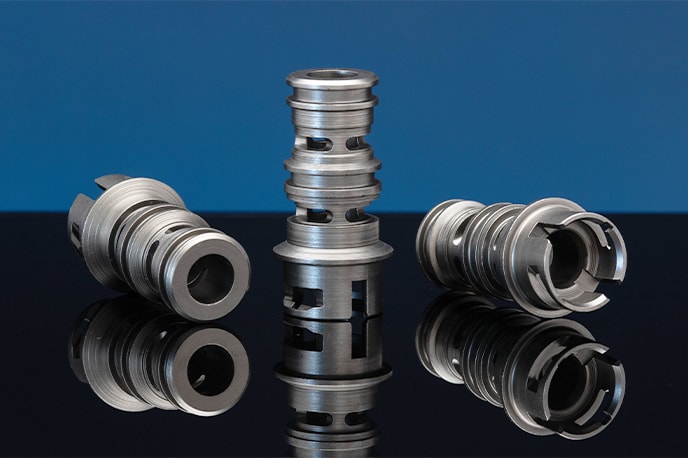
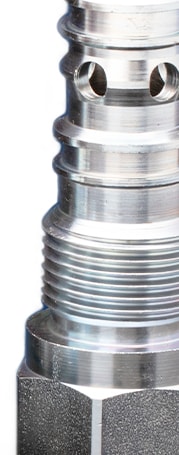
Hydraulic Valve Spools & Cartridges
Critical fluid power turned parts requiring extreme cylindricity, micro-inch surface finishes, and burr-free cross-drilled oil passages.
Material Selection & High-Pressure Coolant Optimization
Machining tough alloys at rapid index speeds requires precise metallurgical mastery and advanced thermal management. DuPage Machine Products integrates high-pressure (up to 2,000 PSI) through-spindle coolant delivery systems to shatter stringy chips in difficult materials such as 316 stainless steel and aircraft-grade aluminum.
Our machine capabilities cover round, hex, and square bar stock sizes ranging from small-diameter precision parts up to high-capacity industrial components. Materials commonly processed on our CNC multi-spindles include:
3. Enterprise Infrastructure: The DuPage Manufacturing Advantage
When evaluating strategic contract manufacturing partners for multi-year high-volume programs, global procurement managers must look beyond basic tooling capabilities. Factory floor capacity, financial stability, quality certifications, and supply chain redundancy dictate long-term partner viability.
245,000 Sq. Ft. World-Class Production Facility
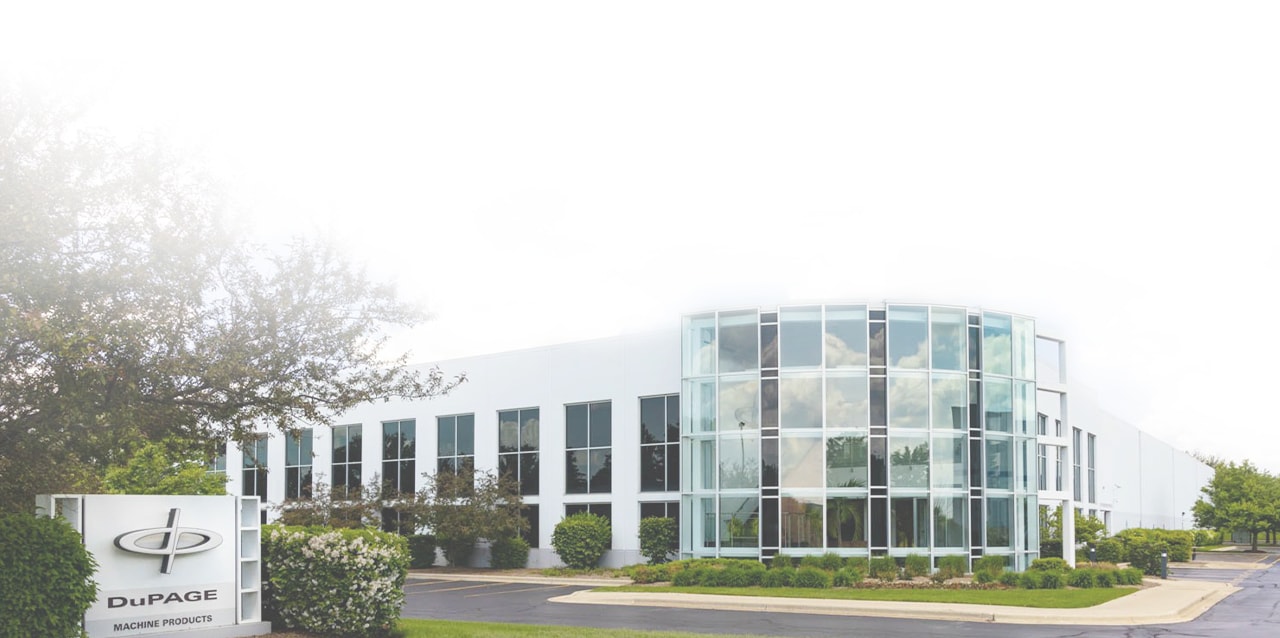
Located in Bloomingdale, Illinois, our climate-controlled facility spans 245,000 square feet and houses over 150 high-end CNC production machines. This massive scale provides unprecedented machine redundancy, eliminating single-point-of-failure risks for high-volume customer supply chains.
Our facility is systematically organized into specialized machining cells, dedicated quality inspection labs, secondary finishing departments, and automated washing and packaging lines designed to handle millions of precision components per month.
Core Competitive Differentiators:
AS9100D & ISO 9001:2015 Dual Certification: Rigorous quality management systems guaranteeing full lot traceability, material heat-treat certification, raw material compliance (REACH/RoHS), and complete PPAP Level 3 documentation.
In-House Tool Manufacturing & Design: Unlike shops that outsource special form tools, DuPage operates an internal tool room equipped with CNC tool grinders and wire EDM. We manufacture custom carbide form inserts, reamers, and collets in-house, cutting prototype and production lead times dramatically.
Advanced Quality Assurance Instrumentation: Cleanroom inspection areas housing automatic shaft measurement units, laser micrometers, surface profilometers, coordinate measuring machines (CMM), and vision inspection systems providing continuous real-time SPC data.
Turnkey Secondary & Assembly Operations: Integrated capabilities including centerless grinding, thread rolling, deburring, automated washing, robotic welding, and contract assembly under one roof.
4. Global Procurement Trends Shaping High-Volume CNC Machining
The global procurement landscape for engineered metal components is undergoing a structural shift driven by geopolitical dynamics, supply chain volatility, and rapid technological advancements. Industrial buyers are shifting from transactional purchasing models toward strategic, long-term partnerships with tech-enabled domestic precision manufacturers.
A. Nearshoring and Re-Shoring Sourcing Strategies
Over-reliance on long lead-time overseas manufacturing has exposed OEMs to elevated freight costs, port delays, tariff uncertainties, and intellectual property risks. Strategic procurement officers are increasingly re-shoring critical turned components to North American manufacturing hubs. DuPage Machine Products' massive domestic multi-spindle capacity offers global buyers shorter lead times, buffer stock flexibility, and direct vendor-managed inventory (VMI) arrangements.
B. Total Cost of Ownership (TCO) vs. Initial Unit Price
Forward-thinking procurement teams evaluate vendor bids through a TCO lens. While a overseas single-spindle quote might appear superficially low, hidden costs—such as buffer inventory holding costs, high shipping rates, late delivery penalties, and quality reject rates—frequently negate nominal savings. High-efficiency CNC multi-spindle turning in the USA provides competitive piece-part pricing combined with near-zero quality risk and reliable JIT (Just-In-Time) delivery.
C. ESG and Sustainable Machining Practices
Environmental, Social, and Governance (ESG) compliance is now a standard metric in global supplier scoring. Modern multi-spindle facilities are reducing carbon footprints through high-efficiency motor drives, closed-loop oil filtration systems, full scrap metal recycling (chips and turnings centrifugally processed to reclaim 98%+ of cutting oils), and energy-efficient LED lighting across production floors.
5. Technological Evolution: The Future of CNC Multi-Spindle Technology
As Industry 4.0 matures, CNC multi-spindle platforms are evolving into highly intelligent, self-optimizing cyber-physical systems. Procurement directors selecting a machining partner must ensure their suppliers are investing in next-generation technological innovations:
Modern multi-spindles utilize embedded piezoelectric sensors and acoustic emission monitoring to detect subtle cutting force anomalies. Before a drill or insert breaks and damages a workpiece or spindle drum, the machine controller automatically flags tool wear, initiates an automatic tool offset correction, or indexes to a back-up tool station without stopping production.
Full Digital Twin Integration & CAM Simulation
Advanced CAD/CAM software allows engineers to simulate complex multi-spindle machining cycles in a 3D digital twin environment. Collision detection, spindle drum index timing, chip load calculations, and tool path optimization occur digitally prior to cutting metal, reducing machine setup times to absolute minimums.
Expert answers to common queries asked by buyers, manufacturing engineers, and sourcing managers.
Q1: What annual production volume justifies shifting from Single-Spindle CNC Lathes to CNC Multi-Spindle Machining?
Typically, production runs exceeding 25,000 to 50,000 units per year represent the economical crossover threshold where CNC multi-spindle machining outperforms single-spindle CNC lathes. While setup times for multi-spindles are longer, concurrent machining across 6 or 8 spindles reduces per-part cycle times by 60% to 80%, substantially lowering piece-price cost for high-volume automotive, hydraulic, and aerospace contracts.
Q2: How does CNC multi-spindle machining differ from traditional mechanical CAM multi-spindle machines?
Mechanical CAM multi-spindle machines rely on physical cams, gears, and change gears to control tool movements. They are fast but require long setups (16–24 hours) and lack versatility. CNC multi-spindles utilize independent servo-controlled axes on every station. This allows programmable feed rates, complex contouring, live tooling operations (cross-milling, offset drilling), thread milling, and rapid digital setups (under 4 hours), while achieving tighter tolerances (±0.0003 in).
Q3: What dimensional tolerances can modern CNC Multi-Spindle platforms maintain during continuous 24/7 production?
State-of-the-art CNC multi-spindles equipped with thermal expansion compensation, glass scale optical encoders, and rigid spindle drum locking mechanisms reliably hold linear tolerances of ±0.0003 inches (±0.0076 mm), turned diameters within ±0.0005 inches, and concentricity within 0.0005 inches across high-volume production cycles.
Q4: What raw material bar stock sizes can be processed on your CNC multi-spindles?
DuPage Machine Products operates a diverse fleet of over 150 high-end machines, capable of handling round, hex, and shaped bar stock ranging from 0.125 inches (3.17 mm) up to 2.00 inches (50.8 mm) in diameter.
Q5: Can multi-spindle CNC equipment complete complex secondary operations like cross-milling, flatting, and back-hole tapping in one setup?
Yes. Modern multi-spindles feature C-axis spindle orientation and driven live tooling at multiple positions. Furthermore, pick-off spindles and back-working slides allow the part to be cut off and machined on the cut-off face (back-drilling, back-countersinking, slotting) prior to ejection, delivering fully finished parts in a single machine setup.
Q6: How does DuPage Machine Products control quality for orders exceeding 1,000,000 parts?
Our AS9100D and ISO 9001:2015 certified quality framework incorporates automated inline vision sorting, high-speed optical shaft measuring, tactile CMM inspection, and Statistical Process Control (SPC). Real-time Cpk monitoring guarantees that dimensions stay centered within tolerance bands across massive production runs.
Q7: What secondary finishing and sub-assembly services do you provide in-house?
DuPage offers comprehensive single-source contract manufacturing. In addition to turned-part machining, our facility provides centerless grinding, precision thread rolling, thermal and mechanical deburring, ultrasonic part washing, robotic welding, and specialized contract assembly operations.
Q8: How do I initiate a formal Request for Quotation (RFQ) for high-volume CNC multi-spindle machining?
You can start by clicking our Get a Quote link to launch an instant consultation with our engineering team, or submit your 2D/3D CAD models (STEP, IGES, PDF), material specifications, annual volumes, and quality requirement details directly to our estimating team.
Partner with a Global Leader in CNC Multi-Spindle Machining
Optimize your high-volume turned part program with lower piece costs, sub-mil precision, and reliable U.S.-based manufacturing capacity. Contact our sales engineering team today to review your drawings and receive a detailed manufacturability analysis.