
Precision Machining Blog
Technical insights, manufacturing news, and expert articles on high-volume CNC precision components.
China Top 10 High Volume Precision Machining Suppliers
Table of Contents
- High-Volume Precision Machining in China: Processes and Industry Metrics
- How to Screen Suppliers: ISO 9001, IATF 16949, and ±0.01 mm Tolerances
- China’s Top 10 High-Volume Precision Machining Suppliers by Capability
- Compare the Top 10: Capacity, Batch Size, Materials, and Lead Time
- How to Verify Quality: PPAP, Cpk ≥1.33, and Traceability Records
- FAQS
- Conclusion
- Related Posts
High-Volume Precision Machining depends on repeatable accuracy, stable cycle times, and disciplined process control. A small variation in a bore or thread can disrupt assembly across thousands of parts. The stakes are practical.
Grand View Research valued the global CNC machine market at US$101.22 billion in 2023. Its report projects continued growth through 2030. This figure covers CNC machines broadly, not precision machining suppliers alone, so it is useful context—not a direct measure of supplier demand. Deloitte and the Manufacturing Institute’s 2024 workforce study also projected that U.S. manufacturing could need 3.8 million workers by 2033, with as many as 1.9 million positions potentially unfilled. For buyers, these trends make automation, skilled operators, and resilient capacity worth examining together.
Manufacturing scholar Jeffrey K. Liker, author of The Toyota Way, offers a relevant production principle: “Create continuous process flow to bring problems to the surface.” Applied to machining, that means watching more than quoted tolerances. Buyers should assess inspection methods, machine uptime, tooling strategy, and documented corrective action. A polished capability sheet is not proof.
This China Top 10 High Volume Precision Machining Suppliers overview is intended as a practical starting point for supplier comparison. Company claims still need verification. A supplier list cannot reveal every shop-floor constraint, and rankings alone can miss a strong technical fit. Check sample parts, quality records, communication practices, and production capacity before making a sourcing decision.
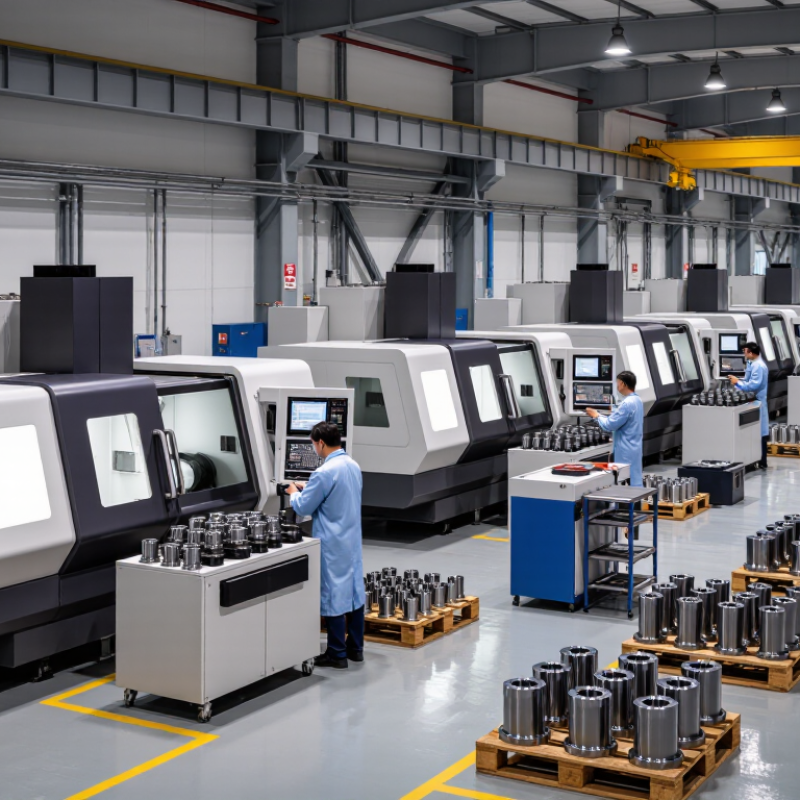
High-Volume Precision Machining in China: Processes and Industry Metrics
High-volume precision machining in China combines repeatable processes with close control of production data. Common operations include CNC turning, milling, grinding, and multi-axis machining. Automated bar feeders and part loaders can reduce idle time, but they do not remove the need for operator checks. Small details matter. A burr on a sealing face, for example, can cause assembly problems across thousands of parts.
Useful metrics include cycle time, first-pass yield, scrap rate, tool life, and overall equipment effectiveness. These figures need context. A short cycle time means little if rework is high, and yield comparisons are unreliable when inspection methods differ. Buyers and suppliers should agree on drawing revisions, sampling plans, measurement equipment, and tolerance requirements before production starts. For critical dimensions, documented inspection results and process capability data can help reveal variation over time. Targets should reflect the part and process, not a generic benchmark.
Stable output also depends on practical controls: consistent material batches, secure fixtures, tool-wear monitoring, and scheduled maintenance. In a real production run, a tool may drift before an alarm catches it. That gap deserves attention. Reviewing measurement trends alongside downtime and scrap records gives teams a clearer picture than a single headline metric. Even a well-planned process can miss something; corrective actions should be recorded and checked on later batches.
How to Screen Suppliers: ISO 9001, IATF 16949, and ±0.01 mm Tolerances
China Top 10 High Volume Precision Machining Suppliers: How to Screen Suppliers
For high-volume machining, a certificate is a starting point, not proof that every part will meet specification. ISO’s 2022 Survey recorded 1,265,216 valid ISO 9001 certificates worldwide. That scale makes the certificate useful as a screening signal, but buyers should still verify its scope, site, and current status. For automotive work, check that IATF 16949 certification covers the actual production location and relevant processes.
A ±0.01 mm tolerance leaves little room for uncontrolled variation. Ask suppliers for recent dimensional inspection reports, the measurement method, and calibration records for key gauges. Review process capability data from a representative production run, not only a first-article sample. A clean report can still hide unstable production. That is worth questioning. Also confirm how the supplier handles tool wear, temperature changes, and nonconforming parts during long runs. These details matter when a cutting tool gradually shifts a bore by several microns.
Tips: Request a sample control plan and anonymized capability study. Check that inspection equipment can resolve the tolerance reliably, then compare the supplier’s results with your own incoming checks. Keep one uncomfortable question in the review: what happens when the process drifts at 2 a.m.?
China’s Top 10 High-Volume Precision Machining Suppliers by Capability
China’s top ten high-volume precision machining suppliers should be compared by capability, not machine count alone. The International Federation of Robotics reported 276,288 industrial robot installations in China in 2023, representing 51% of global installations. This scale signals a strong automation base, but it does not prove that any individual factory can hold tight tolerances across a large batch.
A useful assessment checks spindle uptime, automated part loading, tool-wear control, and inspection capacity. Look for documented process capability, calibrated coordinate-measuring equipment, and traceability from raw material to finished lot. On a shop-floor visit, inspect how operators handle first-piece approval and tool changes. Small details matter. A crowded inspection queue can undermine an otherwise fast production line.
Workforce depth also matters. Deloitte and the Manufacturing Institute estimated that U.S. manufacturing could need 3.8 million workers by 2033, with 1.9 million positions potentially unfilled. That forecast is not a China-specific measure, but it highlights why automation and skilled process engineers deserve separate review. Compare suppliers using evidence: sample inspection records, yield trends, cycle-time stability, and performance across repeat orders. One weakness in this approach is that published capability data can be incomplete; buyers should verify claims against production records and approved samples.
Compare the Top 10: Capacity, Batch Size, Materials, and Lead Time
A useful top-ten comparison starts with verified capacity, not machine counts alone. Request available spindle hours per week, utilization, backup equipment, and inspection capacity. A shop with twenty machines may still bottleneck at five-axis work or final inspection. Ask for evidence. The 2019 Deloitte–MAPI Smart Factory study found that 86% of surveyed manufacturing executives expected smart factories to become a primary source of competitiveness by 2025. For buyers, that makes live scheduling and traceable production data practical capacity signals, not just technology claims.
Batch size changes the comparison. For prototypes and short runs, check setup charges, minimum order quantities, and whether fixtures can be reused. For high-volume work, compare cycle time, scrap controls, and documented process capability across repeat orders. Small batches matter. A supplier quoting 500 parts quickly may not have the same economics or controls for 50,000. Request sample inspection records and a clear basis for any quoted tolerance.
Materials and lead time need equal scrutiny. Ask whether the quoted schedule includes material procurement, heat treatment, finishing, and first-article approval. Compare machining experience with your exact alloy; aluminum, stainless steel, and titanium impose different tool-wear and cycle-time demands. ISO 286 provides a framework for limits and fits, but a drawing’s tolerance still needs review against the chosen process. Public data rarely makes ten suppliers directly comparable, so treat rankings as a shortlist, then verify capacity and delivery assumptions in the RFQ.
China Top 10 High Volume Precision Machining Suppliers - Compare the Top 10: Capacity, Batch Size, Materials, and Lead Time
Indicative comparison of supplier capability profiles, not verified data for named companies or a ranked supplier directory. Capacity and lead-time ranges are planning estimates; actual results depend on part geometry, tolerances, processes, tooling, and order scheduling.
| Profile | Typical Process Focus | Indicative Monthly Capacity* | Typical Batch Size | Common Materials | Indicative Lead Time** | Typical Strength |
|---|---|---|---|---|---|---|
| Profile 1 | CNC turning of standard components | 20,000–80,000 parts | 5,000–30,000 pcs | Aluminum, brass, carbon steel, stainless steel | 3–6 weeks | Repeat production of turned parts |
| Profile 2 | CNC milling for prismatic parts | 8,000–30,000 parts | 1,000–10,000 pcs | Aluminum alloys, stainless steel, engineering plastics | 4–7 weeks | Multi-face machining and configurable production runs |
| Profile 3 | Swiss-type turning for small-diameter parts | 30,000–150,000 parts | 10,000–50,000 pcs | Stainless steel, brass, aluminum, titanium | 4–8 weeks | Small, slender, high-volume turned components |
| Profile 4 | Turn-mill production with secondary operations | 10,000–50,000 parts | 2,000–15,000 pcs | Aluminum, alloy steel, stainless steel, brass | 4–8 weeks | Combining turning, milling, drilling, and threading |
| Profile 5 | High-volume aluminum machining | 15,000–60,000 parts | 3,000–20,000 pcs | 6061 and 7075 aluminum; selected aluminum castings | 3–7 weeks | Lightweight housings, brackets, and structural components |
| Profile 6 | Steel and stainless-steel precision machining | 5,000–25,000 parts | 500–8,000 pcs | Carbon steel, alloy steel, 304/316 stainless steel | 5–9 weeks | Durable components with machining and heat-treatment coordination |
| Profile 7 | Precision machining of copper alloys and brass | 15,000–70,000 parts | 5,000–25,000 pcs | Brass, copper, bronze, aluminum | 3–6 weeks | Fittings, connectors, and electrically conductive parts |
| Profile 8 | Machining of engineering plastics | 5,000–25,000 parts | 500–10,000 pcs | POM, PEEK, nylon, PTFE, polycarbonate | 3–6 weeks | Low-volume to repeat production of non-metal parts |
| Profile 9 | Machining of titanium and difficult-to-cut alloys | 1,000–8,000 parts | 100–2,000 pcs | Titanium, nickel alloys, hardened alloy steel | 6–12 weeks | Specialized materials and more demanding process control |
| Profile 10 | Integrated machining, finishing, and assembly | 5,000–30,000 assemblies | 1,000–10,000 assemblies | Aluminum, steel, stainless steel, brass, engineering plastics | 5–10 weeks | Coordinated machining, surface finishing, inspection, and assembly |
*Capacity is an indicative monthly output range for representative parts and is not directly comparable across different part sizes or process routings. **Lead time is an indicative production window after drawing approval and material availability; sampling, tooling, finishing, and shipping may add time.
How to Verify Quality: PPAP, Cpk ≥1.33, and Traceability Records
For high-volume precision machining, a polished sample is not enough. Ask how the supplier controls the process at full production rate. PPAP should connect the drawing, material certification, inspection plan, tool controls, and approved sample data. Review actual records, not just a presentation. Check revision levels carefully. A mismatch can survive several meetings. For critical dimensions, request capability studies based on a stable process and a defined measurement method. Cpk of 1.33 or higher is a useful benchmark when specified by the customer, but the number needs context. Was it calculated from enough consecutive parts? Was measurement variation checked?
Traceability should link each shipment to its production lot, material heat, machine or cell, and inspection results. Request a sample traveler or electronic record, then see whether a part number and date retrieve the same information quickly. Look for controlled nonconformance handling, calibration status, and verified corrective actions. Keep it practical. During an audit, compare physical parts with their labels and reports. High-volume lines can produce excellent charts while a mislabeled tote slips through. That deserves attention. No supplier is flawless; the useful question is whether weaknesses are visible, contained, and corrected before they repeat.
FAQS
Common processes include CNC turning, milling, grinding, and multi-axis machining. Bar feeders and part loaders can reduce idle time. Operators still need to check parts. Small burrs matter.
Review cycle time, first-pass yield, scrap rate, tool life, and equipment effectiveness. A fast cycle time means little if rework is high. Context matters.
Agree on drawing revisions, sampling plans, measurement equipment, and tolerance requirements. For critical dimensions, request documented inspection results and process capability data. Check later batches too.
No. Verify the certificate’s scope, production site, and current status. Then review inspection reports and actual process controls. A certificate is only a starting point.
Ask for recent inspection reports, measurement methods, and gauge calibration records. Confirm the equipment can reliably resolve the tolerance. Compare results with your own incoming checks.
Ask for available spindle hours, utilization, backup equipment, and inspection capacity. Machine counts alone can mislead. Final inspection may be the bottleneck.
Compare setup charges and minimum order quantities for small runs. For larger orders, review cycle time, scrap controls, and capability across repeat batches. Five hundred parts may not predict fifty thousand.
Check whether it covers material purchasing, heat treatment, finishing, and first-article approval. Ask about experience with your exact alloy. Tool wear can change the schedule. That deserves a second look.
Conclusion
This article explains how China’s High-Volume Precision Machining sector supports manufacturers that need consistent parts in large quantities. It outlines common machining processes and industry metrics, then describes practical ways to screen suppliers, including reviewing ISO 9001 or IATF 16949 certification, checking their ability to hold tolerances such as ±0.01 mm, and assessing production resources and process controls.
A capability-based comparison of ten supplier profiles helps readers evaluate production capacity, batch-size flexibility, material experience, and typical lead times without relying on brand names. The article also covers quality verification: reviewing PPAP documentation, checking whether process capability reaches a Cpk of at least 1.33 where applicable, and confirming that inspection and traceability records are complete. Together, these criteria provide a structured approach to selecting a supplier suited to demanding, repeatable production.

Blog Tags: